Ace Your Interview
07-29-2026
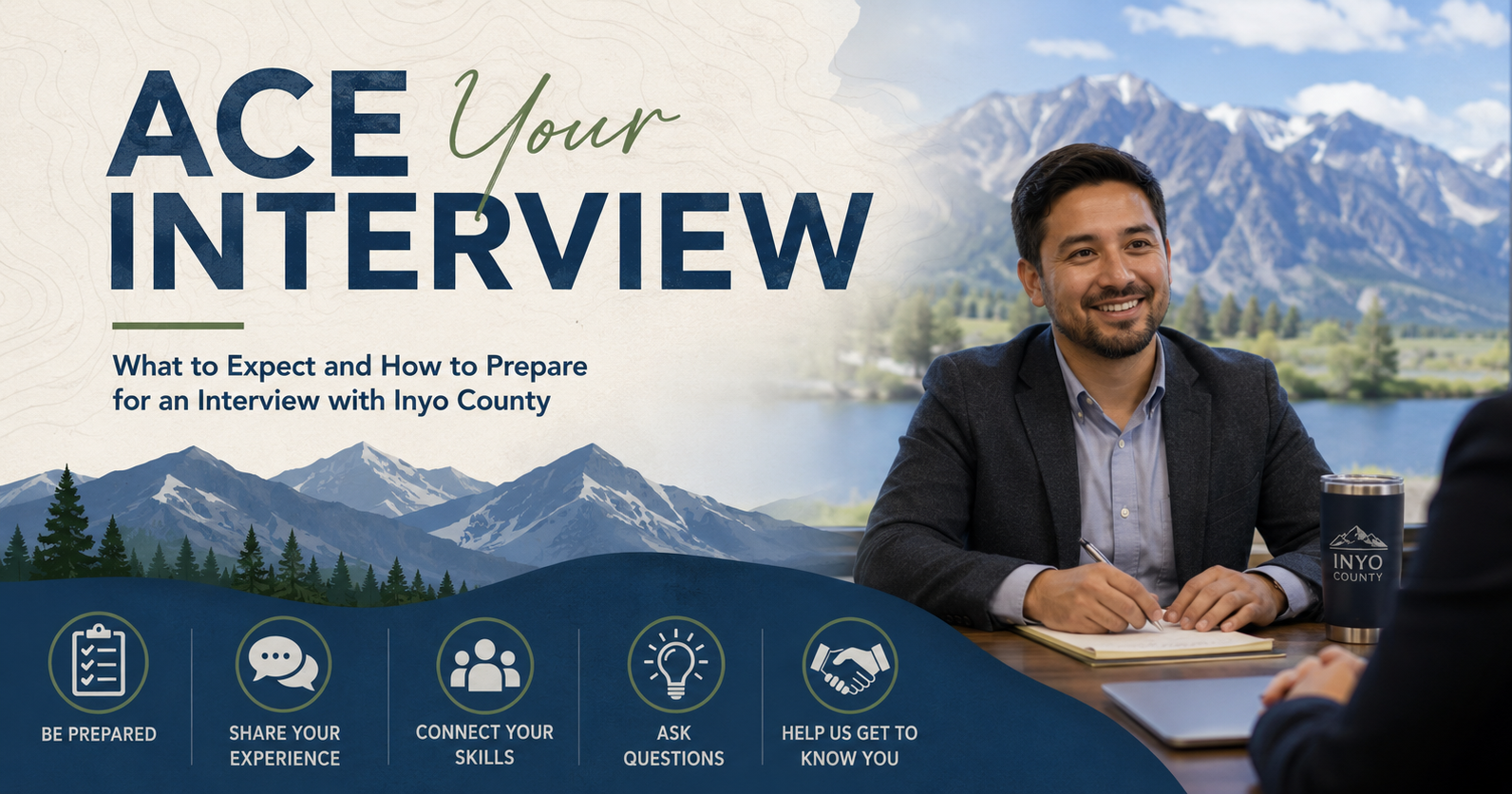
Being invited to interview means you've made it through the initial screening process and now have an opportunity to tell us more about your experience, skills, and what you could bring to the position.
County interviews may feel a little different from interviews you've experienced elsewhere. Knowing what to expect—and taking some time to prepare—can help you feel ready to put your best foot forward.
Watch Your Email—and Keep in Touch
Email is the primary way Inyo County communicates with applicants throughout the recruitment process. Be sure to regularly check the email address associated with your application, including your spam or junk folder, so you don't miss important updates, requests, or interview invitations.
If you're selected for an interview, you'll receive an invitation by email with information about your interview and instructions for responding. Be sure to RSVP to confirm whether you will attend. Receiving an invitation does not automatically confirm your attendance.
When responding, help us know who you are and which interview you're responding to. Candidates often apply for more than one County position, and Personnel may be coordinating several recruitments and interviews at the same time. Include your full name and the position title in your response—even when replying directly to the interview invitation.
For example:
Hi, this is Jane Smith. I'm confirming that I will attend the Office Assistant interview on Tuesday at 10:00 a.m. Thank you!
A quick response with those details helps us confirm your interview and make sure your message is connected to the correct recruitment.
If you need to decline the interview or are unable to attend at the scheduled time, please let us know as soon as possible. If you have questions about your interview, you're always welcome to contact Personnel.
Quick Tip: Whenever you contact Personnel about an application or interview, include your name and the position you're applying for. It helps us help you faster.
Know What to Expect
Interview and selection processes vary depending on the position, but you may interview with a panel of County employees who will ask each candidate the same set of job-related questions.
Some recruitments may also include additional components, such as a written exercise, skills assessment, presentation, or additional interview.
The goal of the process is to give candidates an opportunity to demonstrate their knowledge, skills, experience, and ability to perform the work of the position.
Start With the Job Posting
The job posting is one of your best tools for preparing for the interview. Review the duties, qualifications, and skills or experience the County is seeking. Think about examples from your own experience that demonstrate your ability to perform the work.
Your examples don't have to come only from your current job. Previous employment, volunteer experience, education, and other relevant experiences may all help demonstrate what you can bring to the position.
Take some time to learn about the department and the services it provides, too. Visit the County website, explore the department's pages, and learn what you can about the work they do and the communities they serve.
Have questions about the position? If you don't know someone who works for the County or aren't sure where to start, Personnel is happy to be a resource. Contact us and we'll help answer what we can or connect you with the appropriate department for more information about the position.
Understanding the position and how it serves the community can help you connect your experience to the role and prepare more thoughtful responses during your interview.
What Should I Bring?
In most cases, you don't need to bring anything with you to the interview. The interview panel will have the information and materials needed for the interview.
It is a good idea, however, to have current contact information for your professional references available in case it is requested during the selection process.
Unless you've been specifically asked to provide something, there's no need to bring copies of your application, résumé, cover letter, certificates, or other materials.
When in doubt, just bring yourself and come prepared to talk about your experience.
Answer the Question We Asked
Listen carefully to each question and make sure your response addresses all parts of the question.
It's okay to take a moment to gather your thoughts before answering. If you aren't sure you heard or understood a question, you can ask for it to be repeated.
Most importantly, don't assume the interview panel already knows something about you because it appeared on your application or résumé. Your interview is your opportunity to tell us.
Give Us the Details
Specific examples help the interview panel understand your experience much better than general statements.
For example, if you're asked about handling a difficult situation, don't simply tell us, “I'm good at dealing with difficult customers.” Tell us about a situation you encountered, what made it challenging, what you did, and what happened as a result.
A simple way to organize your response is:
What was the situation? → What was your role? → What did you do? → What was the result?
You don't need to memorize a formula or prepare a scripted response. The goal is simply to give the panel enough information to understand your experience and how you approached the situation.
Interview Tip: A great example doesn't have to be dramatic. Everyday situations can demonstrate communication, judgment, teamwork, leadership, problem-solving, adaptability, and customer service.
Focus on Your Role
When talking about team projects or shared accomplishments, it's natural to say “we.” But the panel also needs to understand your individual contribution.
Explain what you were responsible for, the decisions you made, the actions you took, and how you contributed to the outcome.
If you led a project, tell us how you led it. If you solved a problem, explain what you did. If the result was a team effort, tell us both what the team accomplished and what your role was in making it happen.
Don't Sell Yourself Short
An interview isn't the time to assume your experience speaks for itself. If you've done something relevant, tell us about it.
At the same time, it's okay if you haven't encountered every situation you're asked about. If you don't have a direct example, explain how you would approach the situation using related experience, knowledge, or skills.
We're not expecting every candidate to have experienced every possible scenario. What matters is giving the panel enough information to understand how you think, how you approach your work, and what you could bring to the position.
Questions for Us?
Depending on the interview format, you may have an opportunity to ask questions about the position, department, team, or next steps in the selection process.
This is your opportunity to learn more about the job and the department—and to decide whether the position is a good fit for you, too.
Consider what you genuinely want to know about the position rather than feeling like you need to ask a question simply because you're given the opportunity.
What Happens After the Interview?
After interviews are completed, candidates are evaluated based on the selection process for that recruitment. Successful candidates may be placed on an eligibility list and considered by the hiring department.
Being placed on an eligibility list means you may be considered for the current vacancy or other applicable vacancies during the life of the list; it does not guarantee a job offer.
The hiring process and timeline can vary by recruitment, and some positions may require additional interviews, assessments, or other selection steps before a candidate is chosen.
One Last Tip: Be Yourself
Preparation matters, but you don't need to have a perfectly rehearsed answer to every question. Listen carefully, answer thoughtfully, use examples when you can, and give the panel an opportunity to understand your experience, your approach, and what you could bring to the position.
Getting the interview means we already want to learn more about you.
Now help us get to know you.